MIT Global IDEAS Japan Hosts First Sustainability Dialogue
MIT Global IDEAS Japan Hosts First Sustainability Dialogue
MIT Global IDEAS Japan Hosts First Sustainability Dialogue
MIT Global IDEAS Japan Hosts First Sustainability Dialogue
Press Release
Leadership in a VUCA/BANI Era
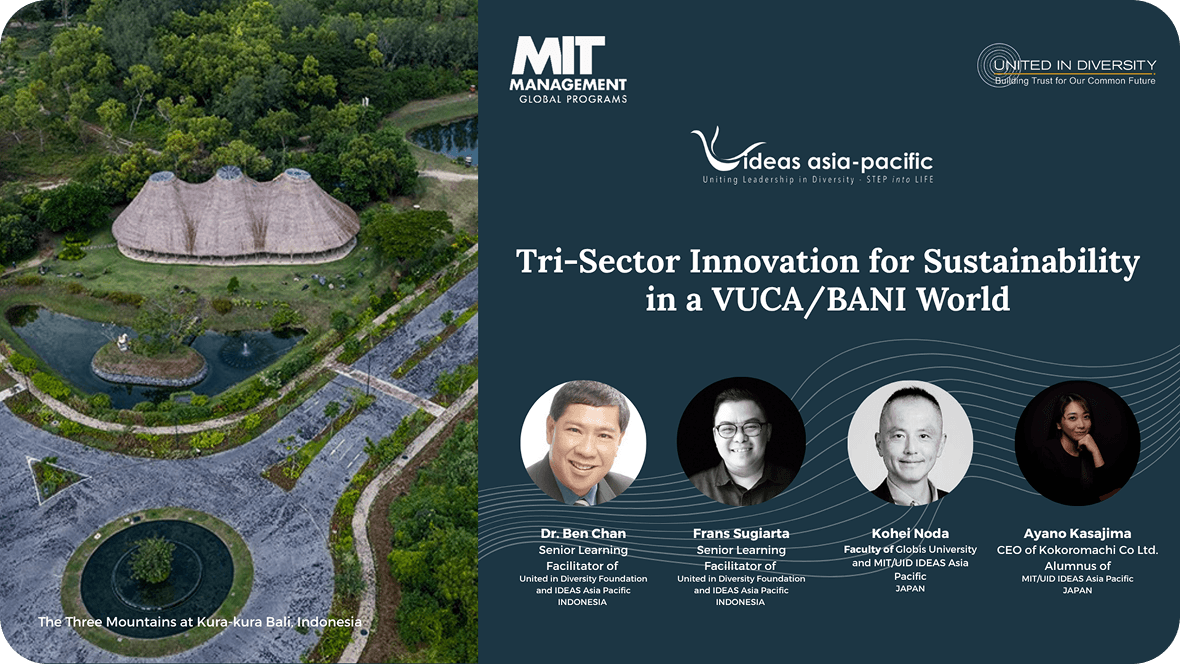
In an era increasingly shaped by uncertainty, technological advancement, and global interconnectedness, MIT Global IDEAS Japan hosted its first discussion dialogue in Japan focused on "Tri-Sector Innovation for Sustainability in a VUCA/BANI World," bringing together leaders, entrepreneurs, alumni, and more than 50 participants from across the Asia Pacific region. The event was organized by GiFT Co., Ltd.
The IDEAS Asia Pacific program, a leadership initiative with more than 20 years of history, originated from research connected to MIT's work on systemic limits to growth and has evolved into an experiential action-research platform focused on sustainability, systems thinking, entrepreneurship, and cross-sector collaboration.
The session featured discussions from faculty, alumni, and current participants — including Dr. Ben Chan, Frans Sugiarta (UID Foundation), Kohei Noda (GLOBIS University), Yui Ioka (Gakken / eunoia partners), and Ayano Kasajima (CEO of Kokoromachi Co., Ltd.).
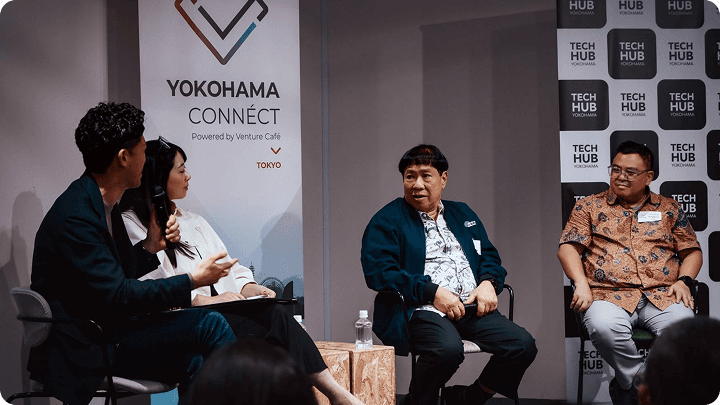
The session featured discussions and reflections from faculty members, alumni, and current participants, including Dr. Ben Chan; Frans Sugiarta (Senior Learning Facilitator at the United in Diversity (UID) Foundation, Jakarta, Indonesia); Kohei Noda (Research Faculty in Leadership and Kokorozashi at the Graduate School of Management, GLOBIS University, Tokyo, Japan); Yui Ioka (Business Development Manager at Gakken Holdings and Co-Founder & CEO of eunoia partners); and Ayano Kasajima (CEO of Kokoromachi Co., Ltd.)
Bridging Japan and the International Market
During the discussion, Ayano shared her experience supporting Japanese corporations in international disclosure and communication, while also helping overseas companies better understand Japan’s business landscape and cultural context.
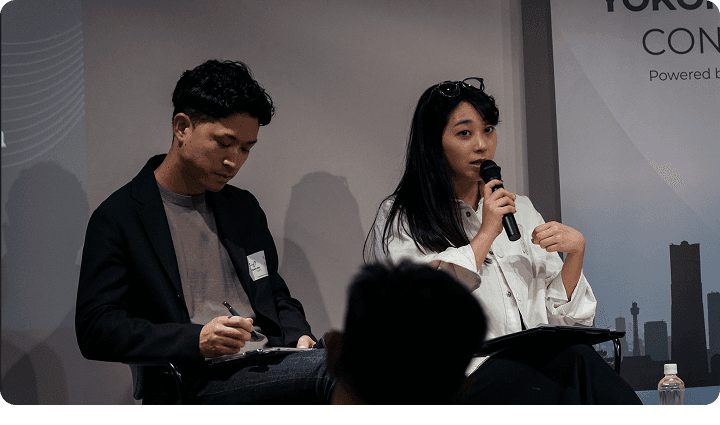
She spoke of communication as something that operates on multiple levels. The exchange of information and transactions is essential to business, yet equally important is the human, grounded layer of communication that builds meaningful bridges between cultures, industries, and markets.
“I’ve always had this learning that sustainability is important.”
Beyond Frameworks, toward Human-Centered Dialogue
Reflecting on her experience working within corporate disclosure frameworks and international communications, Ayano discussed how she gradually came to question the limitations of purely structural or institutional approaches. While such frameworks remain essential to business, she observed, they alone cannot capture the depth of what is being communicated.
She emphasised the importance of authentic dialogue and an understanding of the human stories behind organisations, businesses, and societal systems, particularly in a time increasingly shaped by artificial intelligence, digitalisation, and global uncertainty. In her view, true communication carries value at every layer, from the practical exchange of information and transactions to the deeper, human work of building meaningful bridges between cultures, industries, and markets.
Sustainability as a Long-term Commitment
Another central theme was the importance of viewing sustainability not as a short-term initiative or isolated project, but as a long-term commitment built on trust, collaboration, and shared responsibility.
"It comes down to truly building partnerships, and thinking not just about a single project, but understanding the detailed layers of work and responsibility that come with it." - Ayano Kasajima, CEO, Kokoromachi Co., Ltd.
The discussion explored how leadership in a VUCA/BANI environment requires organisations to move beyond transactional thinking toward the cultivation of collaborative ecosystems. Faculty members highlighted Japan's unique balance between advanced technology and enduring cultural values such as “kokorozashi”, a philosophy centred on purpose, contribution, and meaningful aspiration.
"You are so advanced in your engineering innovation, yet the ideals and values that the Japanese people have are so embedded through this concept of kokorozashi." — Dr. Ben Chan
The importance of Tri-Sector Collaboration
A defining theme of the dialogue was the importance of tri-sector collaboration, bringing together business, government, and civil society to address systemic global challenges. Dr. Ben Chan emphasised that entrepreneurship should be understood not solely through the lens of profit or disruption, but as a force for societal value creation.
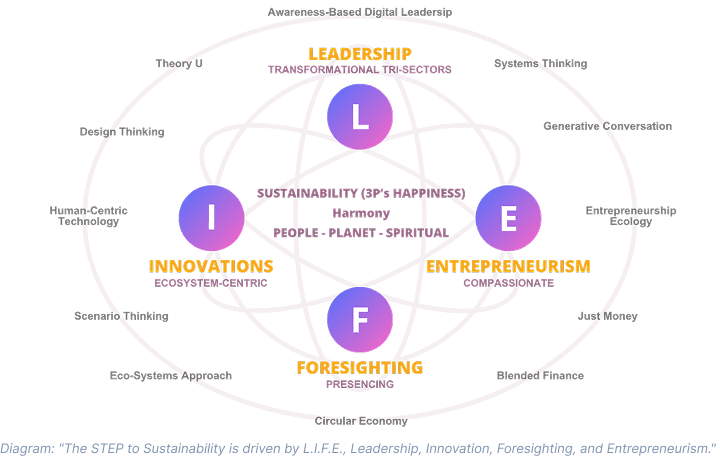
The IDEAS Asia Pacific framework was introduced as the precursor to a future "School of Tri-Sectorism," designed to cultivate leaders capable of operating across institutional and cultural boundaries, with programmes spanning Yokohama, Manila, Boston, Bali, and Jakarta.
Humanity in an Era of Complexity
As the discussion drew to a close, participants reflected on the growing importance of humanity, empathy, and spirituality in a rapidly changing world.
Current participants shared their perspectives on navigating AI disruption and climate-related challenges, while faculty members underscored the importance of engaging younger generations, including Gen Z and Gen Alpha, in shaping the future of sustainability discourse.
The event ultimately reinforced a shared belief: that meaningful innovation in the coming decades will require not only technology and systems thinking, but also deeper human understanding, cross-cultural collaboration, and purpose-driven leadership.
MIT Global IDEAS Japan’s first dialogue session highlighted the growing need for leaders capable of bridging sectors, cultures, and communities to collectively shape a more sustainable and human-centered future.
About MIT Sloan IDEAS Asia Pacific
The MIT Sloan IDEAS Asia Pacific program is a transformational leadership initiative designed to bring together leaders across business, government, and civil society to address complex sustainability challenges through cross-sector collaboration.
Developed in collaboration with United in Diversity (UID), the one-year practice-based program combines systems thinking, innovation, field research, and experiential learning to cultivate leaders capable of navigating today's rapidly changing VUCA (Volatility, Uncertainty, Complexity, Ambiguity) and BANI (Brittle, Anxious, Non-linear, Incomprehensible) world.
Leadership in a VUCA/BANI Era
In an era increasingly shaped by uncertainty, technological advancement, and global interconnectedness, MIT Global IDEAS Japan hosted its first discussion dialogue in Japan focused on "Tri-Sector Innovation for Sustainability in a VUCA/BANI World," bringing together leaders, entrepreneurs, alumni, and more than 50 participants from across the Asia Pacific region. The event was organized by GiFT Co., Ltd.
The IDEAS Asia Pacific program, a leadership initiative with more than 20 years of history, originated from research connected to MIT's work on systemic limits to growth and has evolved into an experiential action-research platform focused on sustainability, systems thinking, entrepreneurship, and cross-sector collaboration.
The session featured discussions from faculty, alumni, and current participants — including Dr. Ben Chan, Frans Sugiarta (UID Foundation), Kohei Noda (GLOBIS University), Yui Ioka (Gakken / eunoia partners), and Ayano Kasajima (CEO of Kokoromachi Co., Ltd.).
The session featured discussions and reflections from faculty members, alumni, and current participants, including Dr. Ben Chan; Frans Sugiarta (Senior Learning Facilitator at the United in Diversity (UID) Foundation, Jakarta, Indonesia); Kohei Noda (Research Faculty in Leadership and Kokorozashi at the Graduate School of Management, GLOBIS University, Tokyo, Japan); Yui Ioka (Business Development Manager at Gakken Holdings and Co-Founder & CEO of eunoia partners); and Ayano Kasajima (CEO of Kokoromachi Co., Ltd.)
Bridging Japan and the International Market
During the discussion, Ayano shared her experience supporting Japanese corporations in international disclosure and communication, while also helping overseas companies better understand Japan’s business landscape and cultural context.
She spoke of communication as something that operates on multiple levels. The exchange of information and transactions is essential to business, yet equally important is the human, grounded layer of communication that builds meaningful bridges between cultures, industries, and markets.
“I’ve always had this learning that sustainability is important.”
Beyond Frameworks, toward Human-Centered Dialogue
Reflecting on her experience working within corporate disclosure frameworks and international communications, Ayano discussed how she gradually came to question the limitations of purely structural or institutional approaches. While such frameworks remain essential to business, she observed, they alone cannot capture the depth of what is being communicated.
She emphasised the importance of authentic dialogue and an understanding of the human stories behind organisations, businesses, and societal systems, particularly in a time increasingly shaped by artificial intelligence, digitalisation, and global uncertainty. In her view, true communication carries value at every layer, from the practical exchange of information and transactions to the deeper, human work of building meaningful bridges between cultures, industries, and markets.
Sustainability as a Long-term Commitment
Another central theme was the importance of viewing sustainability not as a short-term initiative or isolated project, but as a long-term commitment built on trust, collaboration, and shared responsibility.
"It comes down to truly building partnerships, and thinking not just about a single project, but understanding the detailed layers of work and responsibility that come with it." - Ayano Kasajima, CEO, Kokoromachi Co., Ltd.
The discussion explored how leadership in a VUCA/BANI environment requires organisations to move beyond transactional thinking toward the cultivation of collaborative ecosystems. Faculty members highlighted Japan's unique balance between advanced technology and enduring cultural values such as “kokorozashi”, a philosophy centred on purpose, contribution, and meaningful aspiration.
"You are so advanced in your engineering innovation, yet the ideals and values that the Japanese people have are so embedded through this concept of kokorozashi." — Dr. Ben Chan
The importance of Tri-Sector Collaboration
A defining theme of the dialogue was the importance of tri-sector collaboration, bringing together business, government, and civil society to address systemic global challenges. Dr. Ben Chan emphasised that entrepreneurship should be understood not solely through the lens of profit or disruption, but as a force for societal value creation.
The IDEAS Asia Pacific framework was introduced as the precursor to a future "School of Tri-Sectorism," designed to cultivate leaders capable of operating across institutional and cultural boundaries, with programmes spanning Yokohama, Manila, Boston, Bali, and Jakarta.
Humanity in an Era of Complexity
As the discussion drew to a close, participants reflected on the growing importance of humanity, empathy, and spirituality in a rapidly changing world.
Current participants shared their perspectives on navigating AI disruption and climate-related challenges, while faculty members underscored the importance of engaging younger generations, including Gen Z and Gen Alpha, in shaping the future of sustainability discourse.
The event ultimately reinforced a shared belief: that meaningful innovation in the coming decades will require not only technology and systems thinking, but also deeper human understanding, cross-cultural collaboration, and purpose-driven leadership.
MIT Global IDEAS Japan’s first dialogue session highlighted the growing need for leaders capable of bridging sectors, cultures, and communities to collectively shape a more sustainable and human-centered future.
About MIT Sloan IDEAS Asia Pacific
The MIT Sloan IDEAS Asia Pacific program is a transformational leadership initiative designed to bring together leaders across business, government, and civil society to address complex sustainability challenges through cross-sector collaboration.
Developed in collaboration with United in Diversity (UID), the one-year practice-based program combines systems thinking, innovation, field research, and experiential learning to cultivate leaders capable of navigating today's rapidly changing VUCA (Volatility, Uncertainty, Complexity, Ambiguity) and BANI (Brittle, Anxious, Non-linear, Incomprehensible) world.
More insights
More insights
More insights
Hungry for more? Here’s a few more stories from our work bridging Japan and the global market
Hungry for more? Here’s a few more stories from our work bridging Japan and the global market
Hungry for more? Here’s a few more stories from our work bridging Japan and the global market
Hungry for more? Here’s a few more stories from our work bridging Japan and the global market

Kokoromachi Selected for the Ministry of Education’s EDU-Port Japan Program
Kokoromachi Selected for the Ministry of Education’s EDU-Port Japan Program
Press Release
Press Release

The Key Role of Mathematical Modeling in Economic Analysis
The Key Role of Mathematical Modeling in Economic Analysis
Press Release
Press Release

A Single Point Decides Life or Death: The STEAM Concept of "User Ratings"
A Single Point Decides Life or Death: The STEAM Concept of "User Ratings"
Press Release
Press Release
email us at

© 2026 Kokoromachi. All rights reserved.
·
email us at
Navigation
© 2026 Kokoromachi. All rights reserved.
·
email us at
Navigation
© 2026 Kokoromachi. All rights reserved.
·
email us at
© 2026 Kokoromachi. All rights reserved.
·
email us at
© 2026 Kokoromachi. All rights reserved.
·
email us at
© 2026 Kokoromachi. All rights reserved.
·